
Cars invite hands-on maintenance. A repair looks straightforward, and the necessary tools already sit in the garage. However, the consequences of a mistake vary widely from one job to another. Replacing a filter incorrectly might cause poor engine performance, but an error in a brake, steering, or drivetrain repair could affect control of the vehicle. Knowing which auto repairs you should and shouldn’t DIY helps drivers match each project to their experience, equipment, and ability to verify that the finished work is safe.
Repairs You Should DIY
Some maintenance tasks have limited mechanical complexity and offer clear visual checks once the work is complete. These jobs give owners a chance to handle routine service without disturbing systems that directly control steering, braking, or occupant protection.
Replace the Engine Air Filter
An engine air filter prevents dirt, dust, and debris from entering the intake system. As the filter collects contaminants, airflow gradually decreases, and a heavily clogged filter can contribute to sluggish acceleration or reduced engine efficiency.
Most vehicles place the filter inside an accessible plastic airbox secured by clips, screws, or small bolts. Before removing the old filter, note how it sits inside the housing and check the replacement for the correct dimensions. A filter that doesn’t seat against the edges can allow unfiltered air to pass around it, so inspect the seal before closing the housing.
Change the Engine Oil
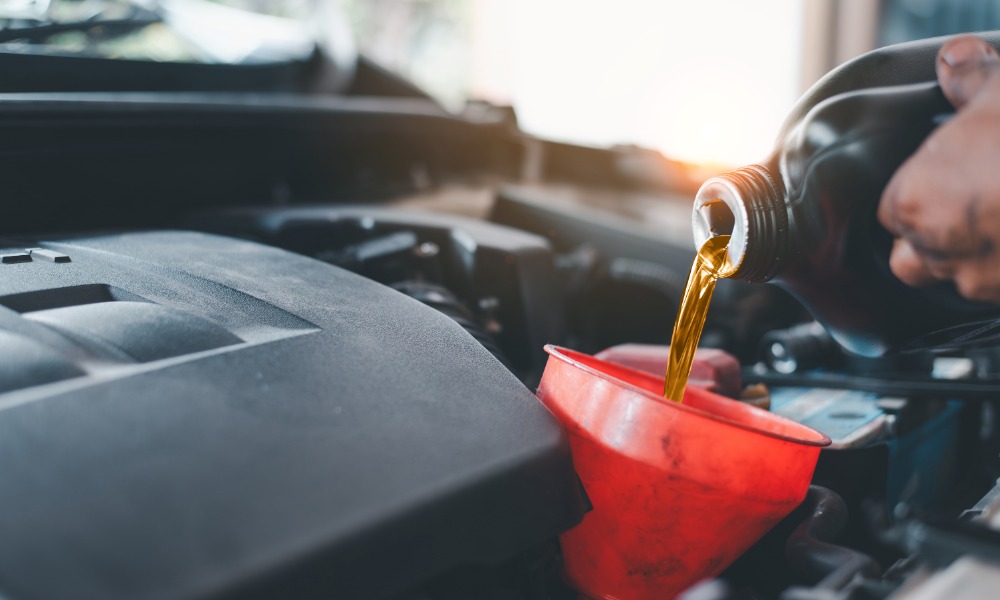
An oil change involves more mechanical work, but many people with basic automotive experience handle it successfully. Engine oil carries heat away from moving components, reduces friction, and suspends contaminants until they reach the filter.
Successful service depends on using the correct oil specification, filter, drain-plug procedure, and fill quantity. The vehicle must sit securely on suitable ramps or jack stands; a hydraulic jack by itself isn’t safe support. After refilling the engine, check the dipstick, inspect the drain plug and filter area for leaks, and confirm the oil level again after the engine circulates the new oil.
Replace a Conventional 12-Volt Battery
Battery replacement involves relatively few steps, but correct cable handling remains essential. Disconnecting the negative terminal first reduces the chance of an accidental short between the positive terminal and grounded metal components.
The replacement battery must match the vehicle’s required size, terminal arrangement, and electrical specifications. Secure the hold-down tightly because a loose battery can shift, damage its case, or strain the terminals. Vehicles with battery-management systems, complex electronics, or registration procedures sometimes require a scan tool after replacement, so owners should check model-specific service information before disconnecting power.
Install an Auxiliary Transmission Cooler
Drivers who tow, haul heavy loads, or operate in demanding conditions may use an auxiliary transmission cooler to control transmission fluid temperature. Compared with opening the transmission itself, the project usually involves accessible external components, including the cooler, brackets, hoses, and transmission cooler lines. That makes the job suitable for owners who already have some experience working around fluid lines and under-hood components.
Installation still depends on correct routing and secure connections. Following reliable tips for installing a transmission cooler clarifies where to mount the cooler, how to secure each connection, and guidelines for routing the lines away from moving parts. After installation, inspect the fittings for leaks and confirm the transmission fluid level because a loose connection or low fluid level can interfere with lubrication and cooling.
Repairs You Shouldn’t DIY
Other repairs involve systems where a small installation error produces much larger consequences. Specialized measuring equipment, diagnostic software, heavy components, stored energy, and precise adjustment procedures place many of these jobs beyond sensible home-garage work for beginner and moderate-level owners.
Internal Transmission Repairs
Automatic and manual transmissions contain tightly fitted components that depend on exact clearances, hydraulic pressure, lubrication, and controlled assembly procedures. Additionally, diagnosing a transmission problem takes more than identifying a single symptom. Slipping, delayed engagement, and unusual noise can indicate several internal faults that produce similar behaviors.
Opening the transmission without proper diagnostic equipment risks replacing the wrong component or introducing debris into sensitive passages. Rebuilding one may involve clutch packs, valve bodies, bearings, seals, gears, and calibrated measurements that demand specialized tools.
Hydraulic Brake and ABS Repairs
Brake pads and rotors sometimes fall within the abilities of experienced home mechanics, but hydraulic and anti-lock braking system work carries substantially greater risk. Brake lines, master cylinders, ABS hydraulic units, and electronic control components must maintain correct pressure and respond predictably during an emergency stop.
Air trapped in a hydraulic circuit can produce a soft pedal and reduce braking response. Contaminated fluid, damaged fittings, improper bleeding, or an undetected leak can produce similar symptoms. ABS repairs can introduce another challenge because some vehicles require diagnostic equipment to command valves or pumps during the bleeding process.
Steering and Major Suspension Work
Steering and suspension components determine how accurately the vehicle responds to driver input and how firmly the tires remain in contact with the road. Repairs involving tie rods, control arms, ball joints, steering racks, or loaded springs require precise installation and, in many cases, a professional alignment afterward.
Spring-loaded components deserve particular caution. A compressed coil spring stores substantial energy, and an incorrect compressor setup can release that force suddenly. Improperly torqued steering or suspension fasteners pose a separate danger because they could loosen after the vehicle returns to the road. Professional shops have lifting equipment, spring tools, alignment machines, and torque specifications that allow technicians to verify the entire repair.
Timing Belt or Chain Repairs
Many engines rely on a timing belt or chain to synchronize the crankshaft and camshaft. That relationship controls when the valves open and close in relation to piston movement, so even a small timing error prevents the engine from running correctly.
On interference engines, incorrect timing can allow pistons and valves to collide. The resulting damage may include bent valves, damaged pistons, or cylinder-head repairs that far exceed the cost of the original service. Access may also require removal of engine mounts, pulleys, covers, and other components. Precise timing marks and tension procedures make this a job best assigned to a technician.
Airbag and Restraint System Repairs
Supplemental restraint systems contain pyrotechnic devices designed to deploy in a fraction of a second during a collision. Airbags, pretensioners, crash sensors, wiring, and control modules therefore demand procedures designed specifically to prevent accidental deployment.
Disconnecting the battery doesn’t automatically make every restraint component safe to handle because stored electrical energy can remain in parts of the system for a specified period. Diagnostic trouble codes also require proper interpretation before replacing components. An incorrect repair could disable the system without producing an obvious physical warning, leaving occupants without expected protection during a crash.
Know Your Auto Repair Skillset
Among the auto repairs you should and shouldn’t DIY, the best decision comes from evaluating the complete repair. If you can’t guarantee that you did the job correctly, professional service is a helpful resource. The goal is to keep your vehicle in great shape while ensuring the safety of each passenger.


