
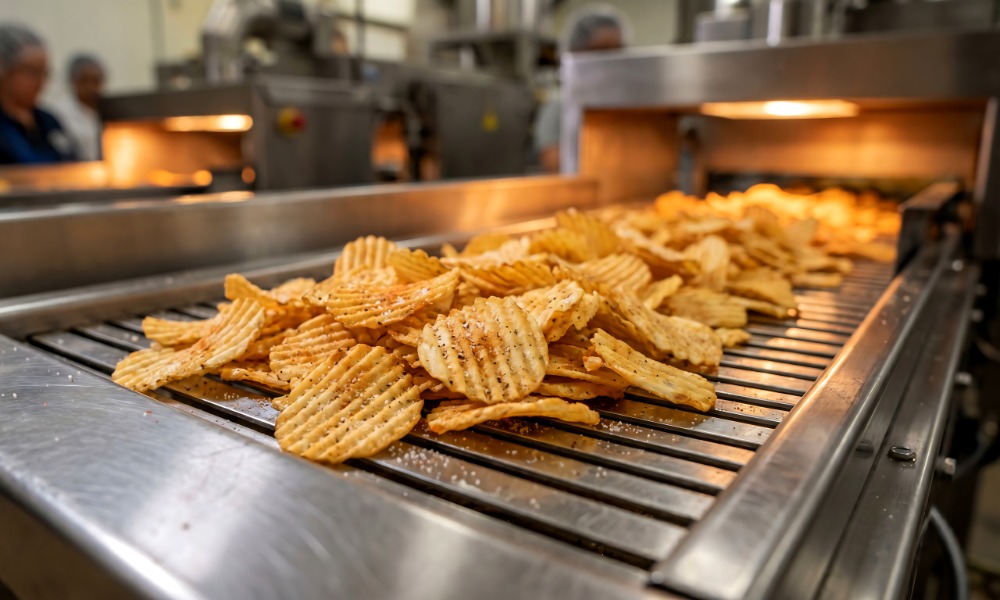
Food manufacturers face a difficult operational challenge when demand grows faster than their physical footprint. Expanding into a larger facility may seem like the obvious response, but relocation, construction, permitting, and new infrastructure can require significant capital and disrupt production.
Scaling food production in limited facility space depends on more than adding faster equipment. Producers must examine how materials move through the plant, where bottlenecks develop, how labor supports each stage, and whether packaging systems can adapt as volume increases.
Start With the Existing Production Flow
Before adding equipment, manufacturers need a clear view of how products, workers, packaging materials, and finished goods move through the facility.
A production line may appear efficient when each machine performs well individually. Problems emerge when the entire system operates as a sequence. A high-speed filler, for example, provides limited value if downstream case packing or palletizing cannot maintain the same pace.
Facility managers can begin by mapping each stage of production from raw material intake through shipping. This process helps identify congestion points, idle equipment, excess travel, and areas where finished goods accumulate.
Reduce Unnecessary Movement
Poor layout design consumes valuable space and creates extra work.
When employees frequently move products between distant stations, the facility loses time as well as usable floor area. Long conveyor runs can create similar problems, especially when the line develops gradually as managers add new machines.
A more efficient arrangement places related processes closer together and reduces unnecessary transitions. Shorter product paths can improve throughput while freeing room for equipment, materials, or staging.
Manufacturers should also review storage practices. Packaging supplies, empty pallets, tools, and maintenance materials can occupy production space that could serve more valuable functions. Moving selected inventory to dedicated storage areas or adopting tighter replenishment schedules can reduce clutter near the line.
Use Automation Where It Removes Constraints
Automation can help food producers increase output without expanding headcount or adding large amounts of floor space. Its value depends on its application.
Repetitive end-of-line tasks provide one important opportunity. Case handling, wrapping, labeling, and palletizing can require substantial labor while also limiting line speed. Automating those steps may allow employees to focus on quality control, material management, equipment oversight, and other work that requires human judgment.
Automation can also support consistency. Machines perform repetitive motions at a predictable pace, which can reduce variation during high-volume production runs.
Consider Modular Packaging Systems
Modular equipment is another strategy for scaling food production in limited facility space because it can provide an advantage when manufacturers expect production requirements to change.
Traditional systems may require a large fixed installation designed around a specific product mix or facility layout. Modular systems give manufacturers more flexibility to adjust their operations as packaging formats, volumes, or production schedules evolve.
This approach can be particularly useful at the end of the production line. Palletizing equipment, for example, must handle cases efficiently without creating a large staging area or blocking nearby operations.
Manufacturers evaluating automation options can review how modular palletizer food packaging machines support production scaling when considering floor space, throughput, and future flexibility together.
Make Better Use of Vertical Space
Limited floor area does not necessarily mean limited capacity.
Food plants may have vacant vertical space that can support conveyors, utilities, storage, or other production functions. Overhead conveyor systems, for example, can move products or packaging materials while preserving valuable floor space for equipment and workers.
Vertical storage can also reduce the footprint for packaging materials, finished goods, and supplies. Proper racking systems can increase storage density without pushing inventory into active production areas.
Any vertical solution must account for safety, sanitation, fire protection requirements, structural limits, and maintenance access. Food production environments also must maintain appropriate separation between clean areas and potential contamination sources.
Standardize Equipment and Processes
Complexity consumes space. A facility that produces many package sizes, case configurations, or pallet patterns may require additional equipment, change parts, storage, and staging areas.
Standardizing packaging formats or production procedures can reduce these demands. Common equipment platforms may also simplify maintenance because technicians can work with familiar components and keep fewer spare parts on hand.
Standardization does not require eliminating product variety. Instead, manufacturers can identify areas where different products can share the same equipment or process.
Improve Changeovers
Changeover time can become a major capacity constraint in facilities that produce multiple products.
Every hour spent cleaning, adjusting, or reconfiguring equipment reduces the time available for production. Manufacturers may respond by adding new lines, even when the existing equipment could support more output with faster transitions.
Teams can examine which changeover steps happen during equipment stoppages and which tasks can take place in advance. Preparing materials, tools, labels, and machine settings before a run ends can shorten downtime.
Equipment design matters as well. Systems with tool-free adjustments, stored recipes, quick-release components, or automated settings can support faster transitions between products.
Plan For Sanitation from the Beginning
A tighter layout can create problems if equipment becomes difficult to clean or inspect. Machines too close to walls, utilities, or neighboring systems may save space initially but increase sanitation time and complicate maintenance.
Producers should consider cleaning access when reviewing every layout change. Equipment should allow workers to reach critical areas, remove debris, and complete sanitation procedures without unnecessary disassembly.
Material selection and machine design also matter. Equipment near exposed food products may require construction that supports washdown procedures or other sanitation protocols.
Measure Capacity Before Expanding
Facility expansion becomes more useful when manufacturers understand the true limits of their current operation.
Production data can reveal whether space is the primary constraint. In some facilities, downtime, slow changeovers, equipment imbalance, maintenance issues, or labor availability create larger limitations than square footage.
Manufacturers can track output by shift, equipment utilization, downtime causes, changeover duration, scrap, and throughput at critical stages. These measurements provide a clearer picture of where manufacturers are losing capacity.
Build Flexibility into Every Upgrade
Demand can change quickly in food manufacturing. Product formats evolve, retailers adjust requirements, and consumer preferences shift.
Equipment that fits today’s production plan may become restrictive if it cannot accommodate different case sizes, pallet patterns, or line speeds. Flexible systems give manufacturers more room to respond without redesigning the entire facility.
That does not mean every machine must handle every possible future requirement. It means businesses should evaluate upgrades based on more than immediate output.
Expand Capacity Before Expanding the Building
Limited space can place real constraints on food production, but physical expansion is not always the first answer.
Manufacturers can create meaningful capacity by improving product flow, reducing unnecessary movement, automating repetitive processes, using vertical space, shortening changeovers, and selecting flexible equipment. These changes can make the existing facility more productive without compromising sanitation or access.
The strongest approach treats space as one part of a larger production system. When equipment, layout, labor, packaging, and material movement work together, manufacturers can increase output while postponing costly facility expansion.
For food producers facing rising demand, the most useful question is how effectively the existing space supports every stage of production.
