
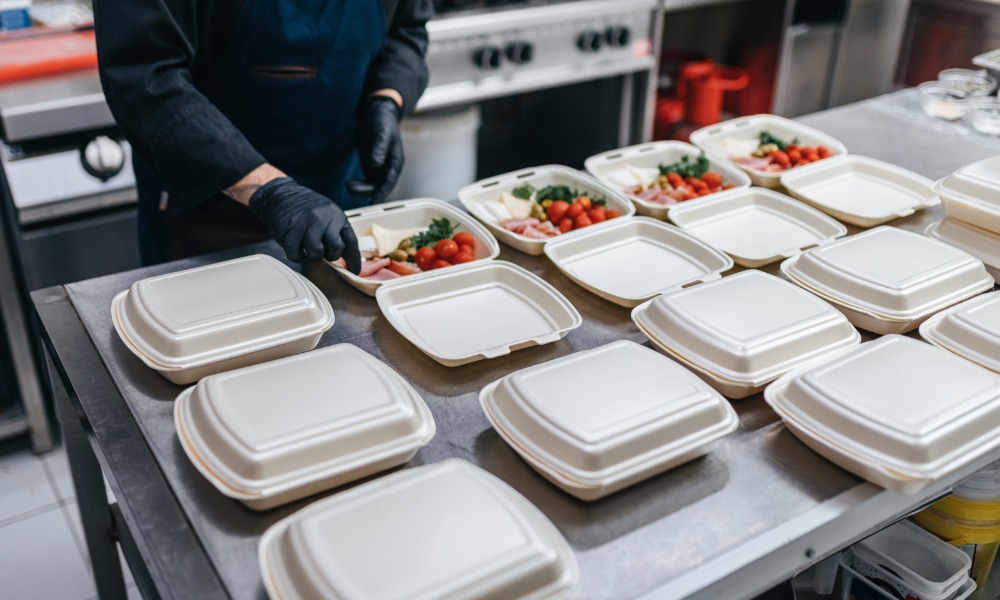
Packaging has become an increasingly important part of the restaurant experience. With takeout, delivery, catering, and grab-and-go services now routine for many businesses, packaging has to do much more than simply hold food. It may need to retain heat, control moisture, prevent leaks, protect presentation, simplify service, and communicate a restaurant’s identity.
That makes restaurant packaging decisions operational decisions as much as visual ones. Changing a container, wrapper, bag, or liner without considering how it performs throughout the entire ordering process can create unexpected costs and service problems. For restaurants planning a packaging update, several factors deserve consideration before new packaging reaches customers.
Start With How the Packaging Will Be Used
A package that works well for one menu item may perform poorly with another. Temperature, grease, moisture, portion size, and transportation time all affect which materials and formats make sense.
Hot sandwiches, for example, may require a wrap that handles grease and helps maintain temperature. Fried foods present a different challenge because excess trapped moisture can undermine texture. Cold or frozen products have their own storage and moisture-control requirements.
Restaurants should evaluate packaging by menu item rather than choosing primarily on appearance. Consider what happens from the moment food leaves the preparation area until the customer opens the package. Testing is especially important for delivery orders. Packaging that performs well during a 5-minute trip across a dining room may behave differently after spending 30 minutes inside an insulated delivery bag.
Understand the Materials Available
Material selection affects appearance, performance, cost, storage, and disposal. Restaurants may encounter paper, paperboard, plastic, aluminum, molded fiber, and various coated materials when reviewing their options.
Even paper products have important differences. Kraft paper, for instance, is produced using a chemical pulping method designed to create particularly strong paper. Understanding what kraft paper is can provide useful context when comparing paper-based options for wraps, bags, liners, and other food-service applications.
The important question is not whether one material is universally better than another; it is whether its characteristics are appropriate for the particular food and service model. Restaurants should also check whether packaging is approved for its intended food-contact application rather than assuming any paper or container can safely be used with food.
Consider Sustainability Claims Carefully
Environmental impact is now a common consideration when businesses update packaging. However, terms such as recyclable, compostable, biodegradable, and renewable describe different characteristics and should not be treated as interchangeable.
A recyclable package, for example, may still face limitations if local recycling programs do not accept the material or if food contamination prevents processing. Compostable packaging may require particular commercial composting facilities that are unavailable in some communities. Restaurants should investigate what happens after customers finish using the package. A sustainability claim is more meaningful when it corresponds with realistic disposal options in the areas where the packaging is used.
Reducing unnecessary material can also be part of the discussion. A simpler package that adequately protects the food may be preferable to a more complicated design containing several layers or components.
Look Beyond the Price Per Unit
Cost naturally influences packaging decisions, but the lowest unit price does not always represent the lowest overall expense. A restaurant may save money on containers but lose some of those savings if the new design takes longer for employees to assemble, requires more storage space, causes leaks, or leads to more remade orders. Conversely, a slightly more expensive format could reduce the need for additional liners, bags, or other components.
Order minimums deserve attention as well. Large orders can lower per-unit costs but require storage space and tie up money in inventory. This becomes particularly important when packaging includes seasonal artwork or branding that could change. The best comparison considers total operational cost rather than the purchase price alone.
Think About Branding Without Sacrificing Function
Packaging offers restaurants a visible place to reinforce their identity, particularly when customers eat somewhere other than the dining room. Color, typography, logos, patterns, and material choices create a more consistent experience. However, branding should not interfere with usability. Attractive packaging that leaks, tears, is difficult to open, or allows food to deteriorate is unlikely to create a positive impression.
Custom printing also introduces practical considerations. Restaurants need to consider print quantities, artwork requirements, production lead times, color limitations, and whether a design is likely to remain relevant throughout the life of the inventory. A relatively simple design can sometimes provide greater flexibility, particularly for smaller restaurants that periodically update menus or visual branding.
Account for Storage and Staff Workflow
Packaging decisions affect employees long before an order reaches a customer. Restaurants generally operate with limited storage and preparation space, making packaging dimensions and stacking characteristics important. Before adopting new packaging, consider where unopened cases will be stored, how much space assembled packages occupy, and whether employees can access them efficiently during busy periods.
Staff should also test the packaging under realistic conditions. Can a container be assembled quickly? Is a wrap easy to fold consistently? Do lids close securely? Can employees identify different sizes at a glance? Minor inefficiencies become more significant when repeated hundreds of times during a busy week.
Test Before Making a Full Transition
Whenever possible, restaurants should trial new packaging before committing to a large order. Testing a representative range of menu items can reveal problems that specifications alone may not show.
Evaluate packages immediately after preparation and again after realistic delivery or holding periods. Look for grease penetration, condensation, temperature loss, leaking, tearing, crushed food, or changes in texture. Employees can provide valuable feedback about handling, while customer comments may identify usability issues overlooked during internal testing.
This stage is also an opportunity to determine whether packaging dimensions are appropriate. Oversized packaging can waste material and storage space, while containers that are too small can compromise presentation or create spills.
Plan the Change as an Operational Project
Updating restaurant packaging can affect purchasing, inventory, food preparation, delivery, storage, branding, and customer experience simultaneously. Treating the change as a small operational project helps prevent details from being overlooked.
Restaurants can begin by identifying what the current packaging does well and where it falls short. From there, priorities can be established for performance, cost, environmental considerations, appearance, and ease of use.
The strongest packaging choice is rarely the one that performs best in only one category. It is the option that balances the restaurant’s menu, service model, workflow, budget, and customer expectations. By testing materials carefully and considering the entire journey from kitchen to customer, restaurants can make packaging changes that improve service rather than simply changing how an order looks.


